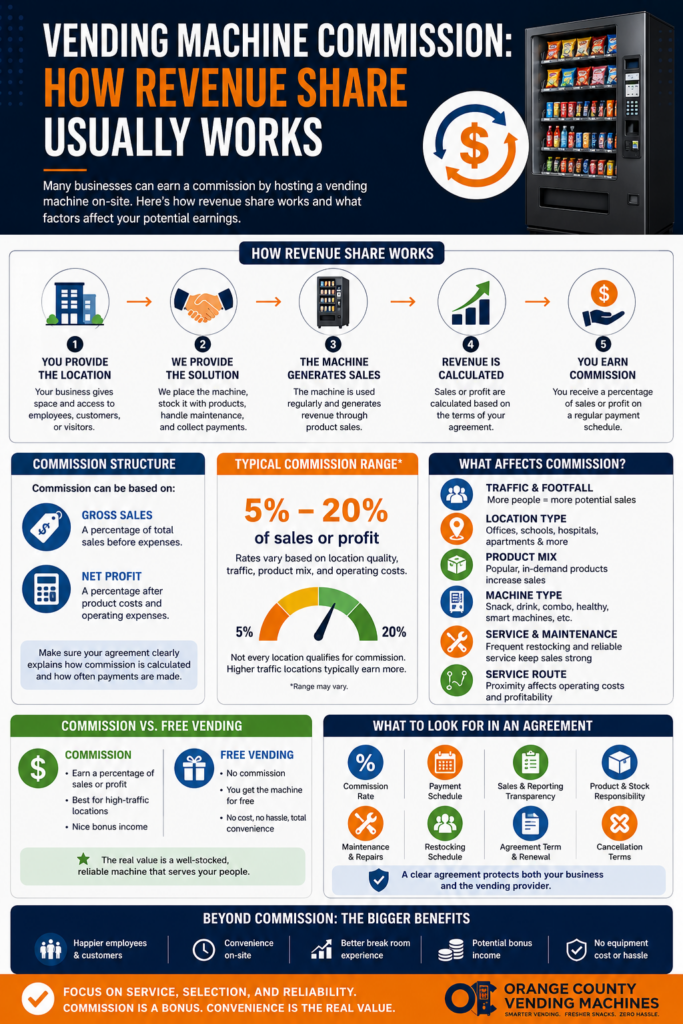
Vending machine commission is one of the first things many business owners ask about when they are thinking about placing a vending machine at their location. It makes sense. If a company is going to put a machine inside your building, serve your employees or customers, and make sales from that machine, it is natural to wonder whether your business gets a share of the money.
The simple answer is that vending machine commission depends on the location, the amount of foot traffic, the type of machine, the products being sold, and the agreement between the business and the vending company. Some locations may receive a percentage of sales or profit. Other locations may receive full-service vending with no commission, especially if the main value is convenience rather than extra income.
This guide explains how vending machine commission usually works, what revenue share means, what affects commission rates, and what businesses should understand before agreeing to host a vending machine.
What Is Vending Machine Commission?
Vending machine commission is a payment made from the vending company to the business, property owner, or organization that allows the machine to be placed on-site. In many cases, the vending company owns the machine, stocks the products, handles maintenance, collects payments, and manages the service. In return for giving the vending company access to the location, the host business may receive a percentage of the machine’s revenue or profit.
Commission is basically a form of revenue share. The business provides the location and access to people who may use the machine. The vending company provides the equipment, products, payment system, service, and restocking. When the machine sells enough products to support the arrangement, both sides may benefit.
However, commission is not automatic in every vending setup. Some locations do not have enough traffic to support both full-service vending and a commission payment. In those cases, the vending company may still be willing to provide a machine, but the main benefit for the business is having snacks and drinks available without buying, stocking, or repairing the machine themselves.
How Does Vending Machine Revenue Share Work?
Vending machine revenue share usually starts with a simple agreement between the vending company and the location. The vending company places the machine at the business, keeps it stocked, handles service calls, and collects the money from sales. If the location qualifies for commission, the vending company pays the business a percentage based on the agreed terms.
The exact payment structure can vary. Some agreements are based on gross sales, which means the commission is calculated from the total money the machine brings in before expenses. Other agreements are based on net profit, which means costs like product inventory, card processing fees, service time, and other expenses may be considered before commission is calculated.
This difference matters because gross sales and profit are not the same thing. A machine may sell a decent amount of product, but the vending company still has to pay for the snacks and drinks, fuel, labor, credit card fees, repairs, and machine upkeep. That is why businesses should always ask how the commission is calculated instead of only asking what percentage they will receive.
Is Vending Machine Commission Based on Sales or Profit?
Vending machine commission can be based on either sales or profit, depending on the agreement. A sales-based commission is usually easier to understand because it comes from the total sales collected by the machine. For example, if a machine makes a certain amount in sales and the commission is based on a percentage of those sales, the calculation is more straightforward.
Profit-based commission is different because it looks at what remains after expenses. This can be more realistic for the vending company because it accounts for product costs and operating expenses. However, it can also be less clear for the host business if the agreement does not explain how profit is being calculated.
Neither structure is automatically better in every situation. What matters most is clarity. A good vending machine commission agreement should explain whether commission is based on gross sales or net profit, how often payments are made, and what records or reports are available to support the payment amount.
What Is a Typical Vending Machine Commission Rate?
There is no single commission rate that applies to every vending machine location. A common range may be somewhere around 5% to 20%, but the actual rate depends heavily on the location and agreement. High-traffic locations with strong sales potential may be able to receive a better commission structure, while smaller locations may receive little or no commission.
The reason commission varies so much is that vending is not just about putting a machine in a building. The vending company has to consider how many people are on-site, how often the machine will need to be restocked, how far the location is from the service route, what products are being requested, and whether the machine is likely to sell enough to justify the cost of service.
A large warehouse, school, hotel, hospital, or busy office may have enough daily traffic to support commission. A small office with only a handful of employees may still benefit from having a vending machine, but there may not be enough sales volume for the vending company to pay commission and still cover costs. That is why commission should be viewed as location-specific, not guaranteed.
Why Some Locations Get Commission and Others Do Not
Some locations receive vending machine commission because they have strong sales potential. A location with a large number of employees, residents, students, guests, or visitors gives the machine more opportunities to make sales throughout the day. When the machine is expected to sell enough products consistently, there is more room for the vending company to share a percentage with the host location.
Smaller locations are different. If a business has low daily traffic or only a small number of people on-site, the machine may produce enough value as a convenience but not enough revenue to support a commission payment. In that situation, the vending company is already taking on the cost of the machine, inventory, delivery, maintenance, and service.
This is why some businesses are offered free vending machine placement without commission. The business still gets snacks and drinks for employees, customers, or guests, and the vending company handles the work. For many businesses, that convenience is more valuable than a small monthly commission check.
What Affects Vending Machine Commission?
The biggest factor affecting vending machine commission is traffic. A machine in a busy workplace or public-facing location has more chances to make sales than a machine in a quiet office with limited daily use. The number of people on-site, how long they stay, and how often they need quick snacks or drinks all play a role.
Product selection also affects commission because not every product has the same profit margin. Drinks, snacks, healthier items, protein products, and specialty items can all have different costs and different selling prices. A vending company has to balance what people want to buy with what is affordable to stock and service. If you are trying to understand product demand more clearly, this guide on what products sell best in workplace vending machines can help explain why the right mix matters so much.
Machine type matters too. A basic snack machine, drink machine, combo machine, refrigerated machine, or smart vending machine may come with different costs. A newer machine with cashless payments, remote monitoring, or refrigeration may improve the customer experience, but it may also cost more to place and maintain. That cost can affect whether commission is available and how much the business receives.
Vending Commission vs. Free Vending Machine Placement
It is easy to focus on commission first, but many businesses get more value from free vending machine placement than from revenue share. With full-service vending, the business does not have to buy the machine, repair it, stock products, track inventory, handle refunds, or deal with payment systems. The vending company takes care of the operation.
Free vending placement can be especially helpful for businesses that want to improve convenience without adding more work. Employees get access to snacks and drinks on-site. Customers or visitors have something available while they wait. Residents or guests can grab something without leaving the property. The business gets a better amenity without having to run a mini-store.
Commission may be a nice bonus when the location has enough volume, but it should not be the only thing a business considers. A reliable machine that is clean, stocked, and working is often more valuable than a slightly higher commission from a company that does not provide good service.
Do Businesses Make a Lot of Money From Vending Machine Commission?
Most businesses should not think of vending machine commission as a major income source. In many cases, it is a small side benefit. The amount depends on how many sales the machine makes, what the commission rate is, and whether the agreement is based on sales or profit.
A high-traffic location may generate enough activity for commission to become a meaningful bonus. But for most ordinary businesses, the bigger benefit is convenience. A vending machine can make the workplace, waiting room, lobby, gym, hotel, apartment community, or facility more useful for the people who spend time there.
That does not mean commission is unimportant. It just means businesses should have realistic expectations. A vending machine can create a small revenue stream in the right location, but it is usually not going to replace the value of better service, better product selection, and a machine that people actually want to use.
What Should Be Included in a Vending Machine Commission Agreement?
A vending machine commission agreement should be clear before the machine is installed. The business should understand who owns the machine, who stocks it, who handles repairs, how product selection is decided, and whether the business receives any commission. If commission is included, the agreement should explain how it is calculated and when payments are made.
It is also helpful to know what happens if the machine does not perform well. Some vending companies may remove or replace a machine if sales are too low. Others may adjust the product mix, change the placement, or recommend a different setup. Businesses should understand these details ahead of time so there are no surprises later.
The agreement should also explain service expectations. A vending machine is only useful if it stays clean, stocked, and functional. Restocking frequency, maintenance response time, refunds, payment issues, and cancellation terms are all worth discussing before the machine is placed.
Is Vending Machine Commission Worth It?
Vending machine commission can be worth it when the location has enough traffic and the agreement is clear. For large offices, warehouses, schools, hotels, apartment buildings, hospitals, and other busy locations, commission can be a useful extra benefit. The location gets a convenient vending setup and may also receive a share of the revenue.
For smaller businesses, commission may not be the most important part of the deal. A small office or lower-traffic location may benefit more from having a full-service vending machine with no equipment cost, no stocking responsibility, and no maintenance headaches. In that case, the value is in the convenience, not the commission.
The best approach is to look at the full picture. Commission matters, but so do machine quality, product selection, service reliability, payment options, placement, and how well the vending company supports the location. A good vending setup should make life easier for the business and more convenient for the people using the machine.
Vending Machine Commission and Machine Type
The type of vending machine can also affect how revenue share works. A simple snack machine may have different costs than a drink machine, combo machine, smart machine, or refrigerated machine. Each machine type has different product capacity, power needs, maintenance requirements, and sales potential.
For example, a business with limited space may only need one machine that offers both snacks and drinks. In that case, comparing a snack vending machine vs. a combo machine can help clarify which setup makes the most sense. A combo machine may be easier for a smaller space, while a larger location may perform better with separate snack and drink machines.
Newer machines may also offer cashless payments, touchscreen displays, remote monitoring, and a more modern look. These features can help improve the customer experience, but they can also affect the cost of placing the machine. When a machine costs more to operate or maintain, the vending company may need stronger sales volume before offering commission.
Should Businesses Ask for Commission?
Businesses can absolutely ask whether commission is available. It is a normal question, especially for locations with steady traffic. The key is to ask in a way that opens the conversation instead of assuming every location automatically qualifies for revenue share.
A good question would be something like: “Does our location qualify for vending machine commission or revenue share?” This gives the vending company room to evaluate the location, daily traffic, product demand, and service requirements. It also helps both sides have a more realistic conversation about what type of arrangement makes sense.
It is also fair to ask how commission is calculated, how often it is paid, and whether sales reports are provided. A trustworthy vending company should be able to explain the structure clearly, even if the answer is that the location does not qualify for commission right away.
Final Thoughts on Vending Machine Commission
Vending machine commission can be a good benefit, but it is only one part of a vending agreement. Revenue share usually depends on traffic, sales potential, product costs, machine type, service needs, and the overall agreement between the business and the vending company. Some locations may receive commission, while others may be better suited for free full-service vending without revenue share.
For most businesses, the best vending setup is one that is reliable, convenient, and easy to manage. A machine that stays stocked, accepts modern payments, offers products people actually want, and fits the location well is often more valuable than chasing the highest possible commission rate.
If your business is considering a vending machine, focus on the full arrangement. Ask about commission, but also ask about service, stocking, product selection, machine type, maintenance, and placement. The right vending company should help you understand what makes sense for your location instead of offering a one-size-fits-all answer.
A vending machine commission can be a nice bonus, but the real value is a convenient, well-stocked machine that serves the people in your building without creating extra work for your business.
Frequently Asked Questions About Vending Machine Commission
Do vending machine companies pay businesses?
Some vending machine companies pay businesses through commission or revenue share, but it depends on the location. A high-traffic business may qualify for commission, while a smaller location may receive full-service vending without a revenue share payment.
What is a normal vending machine commission?
There is no universal vending machine commission rate. Some agreements may fall somewhere around 5% to 20%, but the actual amount depends on sales volume, location quality, product costs, machine type, and service needs.
Is vending machine commission based on sales or profit?
Vending machine commission can be based on either gross sales or net profit. Gross sales means the commission is calculated from total sales before expenses. Net profit means expenses may be considered before the commission is calculated.
Can small businesses get vending machine commission?
Small businesses can sometimes receive vending machine commission, but it depends on traffic and sales potential. If the location does not have enough daily use, the business may still be able to get a vending machine but may not qualify for commission.
Do businesses have to buy the vending machine?
Many businesses do not have to buy the vending machine. With full-service vending, the vending company usually provides the machine, stocks it, services it, and handles maintenance. The business simply provides the location and access.
Who stocks the vending machine?
In a full-service vending arrangement, the vending company stocks the machine. The company is usually responsible for bringing products, filling the machine, rotating inventory, and adjusting the product mix based on what sells.
How often are vending commissions paid?
Vending commission payment schedules vary by agreement. Some companies may pay monthly, while others may pay on a different schedule. The agreement should explain when payments are made and how the commission is calculated.
Is commission better than free vending service?
Commission is not always better than free vending service. For high-traffic locations, commission can be a useful benefit. For smaller businesses, the convenience of having a full-service machine with no equipment cost or stocking responsibility may be more valuable.