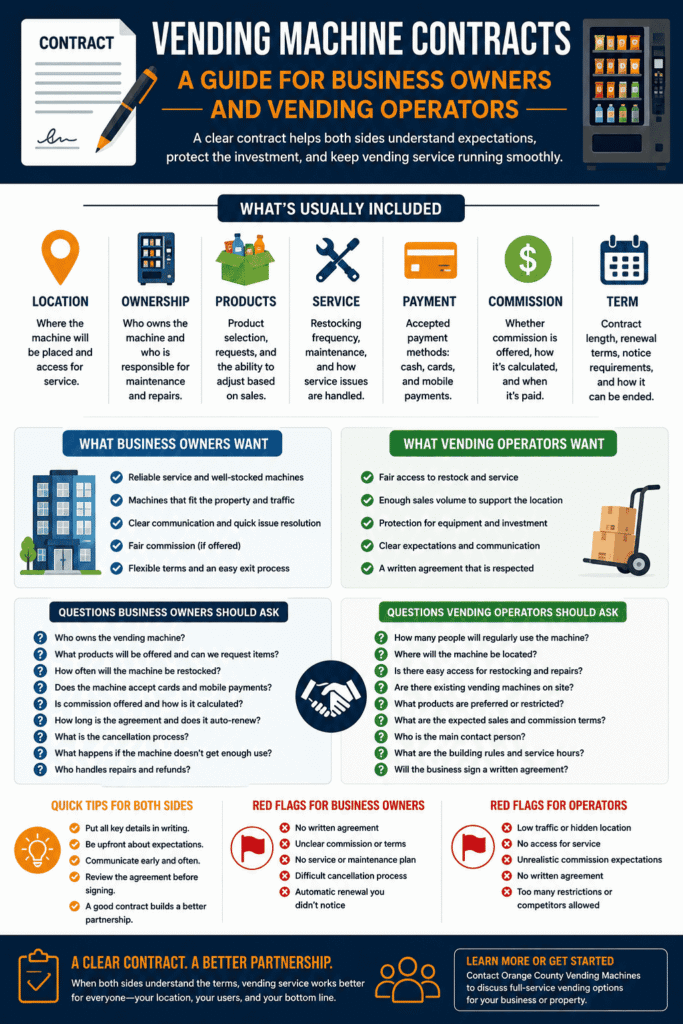
Vending machine contracts do not have to be complicated, but they should be clear.
For business owners, property managers, and facility managers, a vending agreement explains what you are getting, who is responsible for the machine, and what happens if the service is not a good fit. For vending operators, a contract helps protect the equipment, define access to the location, and set expectations before money is spent on machines, product, delivery, and service.
A good vending machine contract should help both sides. The business should feel comfortable with the service being provided, and the vending operator should know that the location is serious, accessible, and worth serving.
This guide explains what vending machine contracts usually include, what business owners should look for, and what vending operators should make clear before placing a machine.
What Is a Vending Machine Contract?
A vending machine contract is an agreement between a business or property and a vending operator.
The agreement usually explains where the vending machine will be placed, who owns it, who stocks it, who handles service, how long the agreement lasts, and whether the business receives commission or another benefit.
In a full-service vending arrangement, the vending operator usually provides the machine, stocks the products, handles maintenance, collects payments, and adjusts the product mix over time. The business provides an approved location, reasonable access, and a suitable place for the machine.
That sounds simple, but a lot of problems can happen when the details are not written down. A contract helps both sides avoid confusion later.
Why Business Owners Should Care About the Contract
For a business owner or property manager, a vending machine can be a nice convenience for employees, residents, customers, guests, or visitors. But even if the vending company owns the machine, the machine is still going inside your building.
That means you should know what you are agreeing to.
Before signing a vending machine contract, business owners should understand:
- Who owns the machine
- Who is responsible for repairs
- How often the machine will be restocked
- What products will be sold
- Whether the machine accepts cards and mobile payments
- Whether the business receives commission
- How long the agreement lasts
- Whether the contract renews automatically
- How the agreement can be canceled
- What happens if the machine is not used enough
The goal is not to overcomplicate the process. The goal is to make sure there are no surprises.
Why Vending Operators Should Use Written Agreements
For vending operators, a written agreement is just as important.
A vending operator may spend thousands of dollars on a machine, card reader, inventory, insurance, fuel, repairs, and service time before making a profit from a location. If there is no written agreement, the operator has less protection if the business suddenly asks for the machine to be removed, brings in another vendor, restricts access, or changes expectations.
A clear vending contract can help operators define:
- Where the machine will be placed
- How long the machine can stay there
- Whether the operator has exclusive vending rights
- How the operator can access the machine
- Who to contact for service issues
- How commission will be calculated
- What happens if sales are too low
- What happens if the machine is damaged
- How either side can end the agreement
Even a simple agreement is better than a handshake when expensive equipment is involved.
Who Owns the Vending Machine?
One of the first things a contract should make clear is ownership.
In many full-service vending agreements, the vending operator owns the machine. The business does not buy the machine, stock it, repair it, or collect the money from it. The vending company handles the work and earns revenue from product sales.
This can be a good fit for businesses that want vending as an amenity but do not want to run a vending operation themselves.
Some businesses choose to buy or lease their own vending machines. That is a different setup. If the business owns the machine, the business may be responsible for stocking, repairs, refunds, expired products, payment issues, and inventory.
Both sides should know the answer before the machine is installed:
Who owns the machine, and who is responsible for taking care of it?
Machine Placement
Machine placement is one of the most important parts of a vending agreement.
A vending machine needs to be in a place where people will actually use it. It also needs to be placed somewhere safe, visible, accessible, and practical for restocking.
Common vending machine locations include:
- Employee breakrooms
- Office kitchens
- Warehouse break areas
- Apartment laundry rooms
- Clubhouses
- Hotel lobbies
- Customer waiting rooms
- Fitness center entrances
- School staff areas
- Medical office waiting areas
The contract should either name the approved location or give both sides a clear process for approving the final placement.
For business owners, placement affects appearance, convenience, and traffic flow. For vending operators, placement affects sales, service access, and whether the machine is likely to perform well.
If you are still deciding where a machine should go, you may also want to read our guide on the best places to put vending machines.
Access for Restocking and Repairs
A vending operator needs reliable access to the machine. If the machine is inside a locked building, gated property, employee-only area, school, apartment clubhouse, or warehouse, access should be discussed before installation.
The contract should explain how the operator can reach the machine for restocking, maintenance, and repairs.
Important access details may include:
- Business hours
- Contact person
- Loading or parking instructions
- Gate codes or entry procedures
- Security check-in rules
- Keys, badges, or escorted access
- Restricted service hours
For business owners, this keeps service organized. For vending operators, it prevents wasted trips and missed restocking visits.
Products and Product Selection
Product selection should be flexible enough to match the location.
An office may want coffee, sparkling water, chips, and protein bars. A warehouse may need cold drinks, energy drinks, and fast snacks. An apartment community may want bottled water, soda, cookies, chips, and snacks residents can grab during laundry or while using shared amenities.
A vending contract does not always need to list every product, but it should explain whether the business can request products and whether the vending operator can replace slow-selling items.
Good questions for business owners include:
- Can we request certain snacks or drinks?
- Can employees, residents, or customers suggest products?
- Are healthier options available?
- Can the product mix change after installation?
- What happens if certain products do not sell?
Good questions for vending operators include:
- Does this location have enough users for the requested products?
- Will the product mix support profitable service?
- Are there product restrictions?
- Will the location allow substitutions based on sales data?
The best vending service usually improves over time. The first product mix is a starting point. Sales data and customer feedback help refine the machine.
Restocking Expectations
Restocking should be clear, but it also needs to be realistic.
A busy warehouse, hotel, apartment community, or large office may need more frequent restocking than a small office with light usage. The schedule should depend on sales volume, machine size, product demand, and the type of location.
Business owners should ask how service works if the machine sells out quickly or if a product gets stuck. Vending operators should avoid promising unrealistic service schedules that are not supported by actual sales.
A contract may not need to promise a specific restocking day every week, but it should make clear that the vending operator is responsible for keeping the machine stocked and responding to service issues in a reasonable way.
Maintenance and Repairs
Maintenance is another area where both sides need clarity.
If the vending operator owns the machine, the operator usually handles machine repairs. This can include issues with card readers, coin mechanisms, bill acceptors, refrigeration, product jams, display screens, and other machine problems.
The business should know how to report an issue. The vending operator should know who to contact if the machine is damaged, unplugged, moved, blocked, or inaccessible.
A vending contract should explain who handles:
- Machine repairs
- Payment problems
- Product jams
- Refund requests
- Refrigeration issues
- Damage to the machine
- Cleaning around the machine
- Reporting service problems
For both sides, the main goal is simple: when something goes wrong, everyone should know what to do.
Payment Options
Modern vending machines often accept more than cash.
Depending on the equipment, vending machines may accept:
- Cash
- Credit cards
- Debit cards
- Mobile payments
- Tap-to-pay options
For many locations, cashless payments are important. Employees, residents, guests, and customers may not carry bills or coins. A machine that accepts cards and mobile payments is often easier to use.
Business owners should ask what payment options are included. Vending operators should make clear whether card readers are available, whether card fees affect pricing or commission, and whether the location has enough signal or connectivity for cashless payments to work properly.
Commission and Revenue Share
Some vending machine contracts include a commission for the business or property. Others do not.
Commission usually means the business receives a percentage of sales or a set payment based on vending revenue. This can make sense for high-traffic locations where the machine is expected to produce enough sales to support the added cost.
Not every location qualifies for commission. Smaller locations may not generate enough sales after product costs, machine costs, card fees, service time, repairs, insurance, and fuel are considered.
Business owners should ask:
- Is commission available?
- How is commission calculated?
- Is commission based on gross sales or net sales?
- How often is commission paid?
- Are there minimum sales requirements?
- What happens if the machine does not sell enough?
Vending operators should be honest about commission. Offering a high commission just to win a location can create problems later if the machine does not produce enough revenue.
For many businesses, the main benefit of vending is not commission. It is convenience for employees, residents, customers, or guests.
Contract Length
Vending contracts can be month-to-month, one year, two years, three years, or longer. The right term depends on the location, machine cost, installation effort, and expected sales.
A vending operator may want a longer agreement if they are placing expensive equipment or multiple machines. A business owner may prefer a shorter trial period if they are not sure whether vending will be used enough.
Before signing, both sides should understand:
- How long the agreement lasts
- Whether it renews automatically
- How much notice is required to cancel
- Whether there are early termination fees
- What happens if the location is sold or closed
- What happens if the machine does not perform well
Automatic renewal language should be easy to find and easy to understand. Nobody should be surprised by a renewal clause months later.
Exclusivity
Some vending contracts include exclusivity. This means the business agrees not to allow another vending operator to place competing machines at the same location during the contract term.
Exclusivity can be reasonable because the vending operator is investing in equipment, products, delivery, and service. But the language should be clear.
Both sides should understand whether exclusivity applies to:
- Snack vending
- Drink vending
- Coffee service
- Micro markets
- Office pantry service
- All buildings on the property
- Only one specific machine location
A business owner should not accidentally agree to more than intended. A vending operator should not assume exclusivity unless it is written into the agreement.
Electricity, Space, and Site Requirements
Most vending machines need a suitable indoor space and access to electricity.
Before a machine is installed, both sides should confirm that the location has enough room, a nearby outlet, safe access, and a practical layout.
Common site requirements include:
- A level floor
- Enough space for the machine
- Room to open and service the machine
- A nearby electrical outlet
- Good lighting
- Reasonable temperature control
- No blocked exits or walkways
- Safe access for customers and service workers
Business owners should not place the machine somewhere that creates a safety or access problem. Vending operators should inspect the location before committing to the placement.
Damage, Insurance, and Liability
Vending machine contracts may include language about damage, insurance, and liability.
This section can vary depending on the vending company, state, property type, and business requirements. Larger locations may ask for proof of insurance before installation.
The contract may address what happens if:
- The machine is vandalized
- The machine is damaged by staff, customers, residents, or visitors
- The machine is moved without permission
- The machine causes property damage
- The location becomes unsafe for service
- The machine must be removed because of building rules
This article is for general information and is not legal advice. Business owners and vending operators should review contract language carefully and speak with a qualified professional if they have legal concerns.
Termination and Machine Removal
A good vending contract should explain how the agreement can end.
This matters for both sides. The business may want the machine removed if it is not being used, if the property changes ownership, or if the space is needed for something else. The vending operator may want to remove the machine if sales are too low, access is too difficult, or the location does not follow the agreement.
The contract should explain:
- How much notice is required
- Who can terminate the agreement
- Whether early termination fees apply
- How the machine will be removed
- When the final commission payment is made, if applicable
- What happens if the machine is damaged before removal
It is better to talk about the exit process before the machine is installed, not after there is already a problem.
Red Flags for Business Owners
Business owners should be cautious if a vending agreement is vague or hard to understand.
Potential red flags include:
- No clear explanation of who owns the machine
- No service or maintenance process
- Unclear commission terms
- A long contract with no reasonable way to cancel
- Automatic renewal language that is easy to miss
- No explanation of who handles repairs
- No contact process for service issues
- No clear removal process
- Promises made verbally but not written down
A vending contract does not need to be intimidating. It just needs to be clear.
Red Flags for Vending Operators
Vending operators should also be careful before placing equipment.
Potential red flags include:
- The location will not sign any written agreement
- The machine must be hidden in a low-traffic area
- Access is restricted or unclear
- The business expects high commission from a low-traffic location
- The location wants expensive equipment without enough users
- The business will not provide a contact person
- The machine area has no good outlet or safe placement
- The property wants the operator to remove the machine at any time with no notice
- The business allows competing machines nearby
Not every location is worth taking. A contract helps operators decide whether the opportunity makes sense before investing time and equipment.
Questions Business Owners Should Ask Before Signing
Before signing a vending machine contract, business owners should ask:
- Who owns the vending machine?
- Who stocks the machine?
- Who handles repairs?
- What type of machine will be installed?
- Where will the machine be placed?
- What products will be included?
- Can we request certain products?
- Does the machine accept cards and mobile payments?
- How often will the machine be restocked?
- How do we report service issues?
- Is commission available?
- How is commission calculated?
- How long does the agreement last?
- Does the contract renew automatically?
- How can either side cancel?
- Is there an exclusivity clause?
- What access does the vending company need?
- Who handles refunds?
- What happens if the machine does not get enough use?
- How is the machine removed if the agreement ends?
Questions Vending Operators Should Ask Before Placing a Machine
Before placing a machine, vending operators should ask:
- How many people are regularly on site?
- Who will use the machine?
- Where will the machine be located?
- Is the location visible and convenient?
- Is there a nearby outlet?
- Can the machine be accessed for service?
- Are there existing vending machines on site?
- Does the business expect commission?
- Are there product restrictions?
- Does the location want snacks, drinks, or both?
- Who is the main contact person?
- What are the service access hours?
- Is the property secure enough for the machine?
- Does the expected sales volume justify the equipment?
- Will the business sign a written agreement?
Related Vending Guides
If you are still comparing vending options, these guides may help before you sign an agreement:
- How Much Does Vending Machine Service Cost?
- Snack Vending Machine vs. Combo Machine: Which Is Better?
- Best Places to Put Vending Machines
What Should Both Sides Want From the Agreement?
The best vending contracts are not about one side winning and the other side losing.
Business owners want reliable vending service, clear expectations, responsive maintenance, and a machine that fits the property. Vending operators want fair access, reasonable terms, enough sales volume, and protection for their equipment.
A strong agreement should make the relationship easier, not harder.
Both sides should leave the conversation knowing:
- Where the machine will go
- Who owns it
- Who services it
- How products are chosen
- How payment and commission work
- How long the agreement lasts
- How problems are reported
- How the agreement can end
Vending Machine Contracts Should Be Clear, Practical, and Fair
A vending machine contract does not need to be full of confusing language. It should explain the basics in a way both sides can understand.
For business owners, the contract protects the property and sets expectations for service. For vending operators, the contract protects the machine, the route, and the investment required to serve the location.
The most important thing is clarity.
If a detail matters, it should be written down. That includes ownership, placement, access, service, product selection, commission, contract length, exclusivity, cancellation, and machine removal.
When both sides understand the agreement, vending service is much more likely to run smoothly.
Request Vending Machine Service
If your business, apartment community, office, warehouse, hotel, school, gym, medical building, or commercial property is considering vending service, start by gathering a few basic details.
Helpful information includes your property type, approximate number of people on site, preferred machine location, available space, access hours, and whether you are interested in snack, drink, combo, or specialty vending options.
Orange County Vending Machines helps qualifying locations explore full-service vending options, including machine placement, product selection, restocking, and ongoing service.
To discuss vending service for your property, contact Orange County Vending Machines.